Answer Engine Optimisation: How to Get Cited by AI
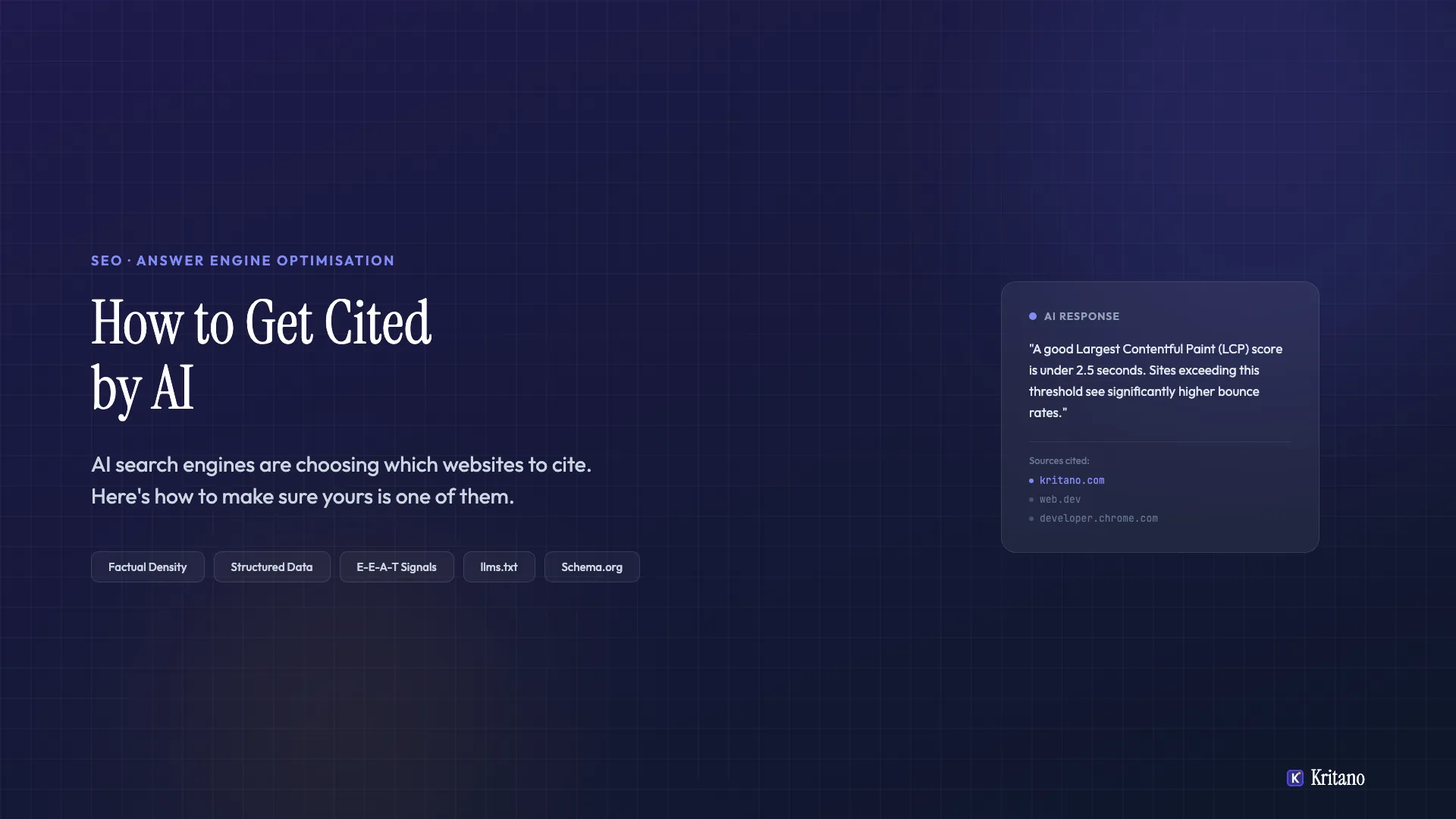
Have you ever asked ChatGPT, Perplexity, or Google's AI Overview a question and noticed that it cites specific websites in its answer? Maybe it quoted a stat from one site, linked to another for "further reading", or named a particular tool as the recommended option. That's not random. Those sites got cited because their content was structured in a way that AI could understand, trust, and reference.
This is answer engine optimisation - AEO for short - and it's quietly becoming as important as traditional SEO. If you've spent years optimising for Google's blue links, you now need to think about a second audience: the AI models that are increasingly answering questions on behalf of your potential customers.
What Is Answer Engine Optimisation?
Answer engine optimisation is the practice of structuring your website's content so that AI-powered search engines - like ChatGPT, Perplexity, Google AI Overviews, and Claude - are more likely to cite it in their responses.
Traditional SEO is about ranking on a search results page. AEO is about being the source that an AI quotes when someone asks a question.
Think of it this way: when someone Googles "best website audit tools", they see a list of links and choose which one to click. But when someone asks ChatGPT the same question, the AI reads hundreds of pages, synthesises the information, and generates a single answer - often citing 3-5 sources. If your page is one of those sources, you've just been recommended directly to the user by an AI assistant. That's a different kind of visibility altogether.
Why AEO Matters Now
This isn't a future trend - it's happening right now. The numbers are hard to ignore:
AI search is mainstream. ChatGPT has over 200 million weekly active users. Perplexity processes millions of queries daily. Google's AI Overviews appear on a growing percentage of search results. When people use these tools, they're not clicking through to 10 blue links - they're getting answers directly, with citations.
Zero-click search is accelerating. Studies estimate that over 60% of Google searches now result in zero clicks - the user gets their answer without visiting a website. AI Overviews make this worse for traditional SEO, but better for sites that get cited as sources within those overviews.
AI models have memory and preference. Large language models don't randomly choose sources. They favour content that is factually dense, well-structured, authoritative, and unambiguous. If your content consistently shows up as a reliable source during training and retrieval, you build a compounding advantage.
The honest truth is that nobody knows exactly how AI citation algorithms work - they're less transparent than Google's ranking factors. But we do know enough about how these models process and prioritise information to make meaningful improvements.
How AI Decides What to Cite
Before jumping into the practical steps, it helps to understand what AI models are looking for when they choose which sources to reference. Based on how retrieval-augmented generation (RAG) systems work - the technology behind most AI search products - there are a few clear patterns:
Factual Density
AI models love content that makes specific, verifiable claims. "Website speed is important" gives the AI nothing to cite. "53% of mobile users abandon a site that takes longer than 3 seconds to load (Google, 2018)" gives it a concrete fact it can reference and attribute.
The more specific data points, named technologies, precise definitions, and cited statistics your content contains, the more useful it is to an AI trying to construct an accurate answer.
Clear Structure
AI parses content hierarchically. A well-structured page with descriptive H2/H3 headings, short paragraphs, and logical flow is significantly easier for a model to extract information from than a 3,000-word wall of text. Headings act like labels on filing cabinets - they tell the AI exactly where to look for specific information.
Authority Signals
AI models weigh the credibility of sources. Pages with author attribution, organisation credentials, cited sources, and consistent publishing history are treated as more authoritative than anonymous blog posts. This overlaps heavily with Google's E-E-A-T framework - Experience, Expertise, Authoritativeness, and Trustworthiness.
Unambiguous Answers
AI prefers content that directly answers questions without excessive hedging. "The recommended LCP threshold is 2.5 seconds or less" is citable. "LCP can vary depending on many factors and there's no single right answer" is not.
This doesn't mean you should never add nuance - but lead with the clear answer, then add the caveats.
Step 1: Structure Your Content for Extraction
The single most impactful thing you can do for AEO is to structure your content so AI can extract discrete facts from it.
Use descriptive headings that match common questions. If people ask "what is a website audit?", have an H2 that says "What Is a Website Audit?" with a clear, concise answer immediately below it. This heading-then-answer pattern is exactly how AI models locate relevant content.
Front-load the answer. In journalism, this is called the inverted pyramid - put the most important information first. Don't build up to the answer over three paragraphs. State it clearly in the first sentence of the section, then elaborate.
Use definition patterns. Phrases like "X is..." or "X refers to..." create clear, extractable definitions that AI models can quote directly. For example: "Answer engine optimisation (AEO) is the practice of structuring content so AI-powered search engines cite it in their responses."
Step 2: Maximise Factual Density
Go through your content and ask: how many specific, citable facts does this page contain?
- Include statistics with sources. Not just "most users prefer fast sites" but "53% of mobile users abandon sites that take over 3 seconds to load."
- Name specific tools and technologies. Not "use an SEO tool" but "use Google's PageSpeed Insights, Lighthouse, or Kritano to measure your Core Web Vitals." For AEO specifically, you need a tool that checks structured data, content quality, and E-E-A-T signals - not just performance. Compare the best audit tools for AEO readiness.
- Use precise definitions. Not "LCP is about loading speed" but "Largest Contentful Paint (LCP) measures the time it takes for the largest visible element - typically a hero image or heading - to render on screen."
- State thresholds and benchmarks. Not "your site should be fast" but "Google recommends an LCP under 2.5 seconds, an INP under 200 milliseconds, and a CLS under 0.1."
Every specific claim is a potential citation. Every vague statement is a missed opportunity.
Step 3: Implement Structured Data
Structured data - specifically Schema.org markup in JSON-LD format - is how you make your content machine-readable. While AI models can parse plain HTML, structured data gives them explicit signals about what your content represents.
The schema types that matter most for AEO:
- Article - For blog posts. Include
headline,author,datePublished,dateModified,publisher, andkeywords. - FAQPage - For content structured as question-and-answer pairs. This is extremely citation-friendly because each Q&A is a discrete, extractable unit.
- HowTo - For step-by-step guides. Each step becomes a named, ordered instruction that AI can reference.
- Person - For author pages. Establishes the expertise and identity of the person behind the content.
- Organisation - For your company. Connects your content to an entity that AI models can build a knowledge graph around.
You don't need to implement all of these on every page. Match the schema type to the content type. A how-to guide gets HowTo schema. A FAQ page gets FAQPage schema. Every blog post gets Article schema.
Step 4: Build E-E-A-T Signals
Google's E-E-A-T framework - Experience, Expertise, Authoritativeness, and Trustworthiness - is the closest thing we have to a shared framework for content quality across both traditional search and AI citation.
Practical steps:
- Create a dedicated author page with a bio, areas of expertise, and links to social profiles. Link every blog post's author byline to this page.
- Use Person schema on the author page with
knowsAbout,jobTitle,worksFor, andsameAs(social profile URLs). - Cite your sources. When you reference a statistic or external claim, link to the original source. This signals to both human readers and AI that you're building on verified information.
- Publish consistently. A site with 50 well-written articles across a clear topic cluster is more authoritative than a site with 3 posts published last year.
- Show your experience. Use first-person accounts, reference your own projects, and provide opinions backed by real work. AI models can distinguish between regurgitated content and content that demonstrates genuine expertise.
Step 5: Create an llms.txt File
This one is specific to AEO and has no equivalent in traditional SEO. An llms.txt file - placed at your site's root, similar to robots.txt - is a plain-text file designed to help AI models understand your site.
It's not an official standard yet, but it's gaining traction and several AI companies have acknowledged it. The file typically includes:
- A concise description of what your site or product does
- Your core services or product features
- Pricing information
- Key differentiators
- Links to your most important content
Think of it as your elevator pitch, formatted for AI consumption rather than human consumption. Keep it factual, specific, and structured.
Step 6: Make Your Content Crawlable by AI
AI crawlers - GPTBot (OpenAI), ClaudeBot (Anthropic), PerplexityBot, and others - need to access your rendered HTML to index your content. If your site is a single-page application (SPA) built with React, Vue, or Angular, the HTML that crawlers see might be an empty <div id="root"></div> with no actual content.
Solutions:
- Server-side rendering (SSR) - Render pages on the server so crawlers get complete HTML.
- Pre-rendering - Use a service that detects bot user agents and serves them a pre-rendered HTML snapshot. This is what most SPAs use for Google SEO, and it works equally well for AI crawlers.
- Check your robots.txt - Make sure you're not blocking AI crawler user agents. Some sites block GPTBot or ClaudeBot by default, which means those AI models can't see your content at all.
The Honest Trade-Off
AEO is still early. There's no equivalent of Google Search Console for AI citation - you can't see exactly when and how often AI models reference your content. The feedback loop is slow and opaque. You'll need to manually search for your brand in ChatGPT, Perplexity, and Google AI Overviews to gauge whether your efforts are working.
There's also a philosophical tension: if AI gives users the answer directly, citing your page, does that user ever actually visit your site? In many cases, no. But here's what I've observed - being cited by AI builds brand awareness and trust in a way that a page-2 Google ranking never does. When an AI assistant says "according to Kritano, a good LCP score is under 2.5 seconds", that's a direct endorsement. People remember the source even if they don't click through.
The businesses that will benefit most from AEO are those that are already producing high-quality, factually dense content. If your content is thin, vague, or derivative, no amount of structured data will help. The fundamentals still matter.
Wrapping Up
Answer engine optimisation isn't a replacement for SEO - it's an extension of it. The good news is that most AEO best practices (clear structure, factual density, authority signals, structured data) also make your content better for traditional search. You're not optimising for two competing audiences; you're optimising for one standard of quality that both search engines and AI models reward.
Start with the content you already have. Pick your most important pages, add structured data, tighten up the headings, increase the factual density, and make sure AI crawlers can access them. Then, as you publish new content, build these practices in from the start.
If you want to see how your site scores on AEO readiness - alongside SEO, accessibility, security, and performance - join the waitlist now! I'll walk you through exactly where you stand and what to improve first.

Founder of Kritano
5 years in web development. I specialise in web auditing, WCAG 2.2 compliance, and search engine optimisation.
I built Kritano after years of running audits with fragmented tools. I write about SEO, accessibility, security, and performance based on real auditing data from thousands of scans.