What Is a Website Audit and Why Does It Matter?
Have you ever wondered what's actually going on behind the scenes of your website? You might look at it every day and think it's fine - it loads, the pages are there, the contact form works. But beneath the surface, there could be dozens of issues silently hurting your search rankings, turning away visitors, or even exposing your business to security risks.
That's what a website audit is for. It's a comprehensive health check that looks at everything from how Google sees your site to whether a screen reader can navigate it. I'll break down exactly what a website audit covers, why it matters for your business, and what you should actually do with the results.
A Website Audit in Plain English
A website audit is a systematic review of your website across multiple dimensions - not just how it looks, but how it performs, how search engines understand it, how secure it is, and how accessible it is to everyone.
Think of it like an MOT for your website. Your car might start every morning and get you to work, but that doesn't mean the brakes are in good shape or the emissions are within limits. A website audit checks the things you can't see from the driver's seat.
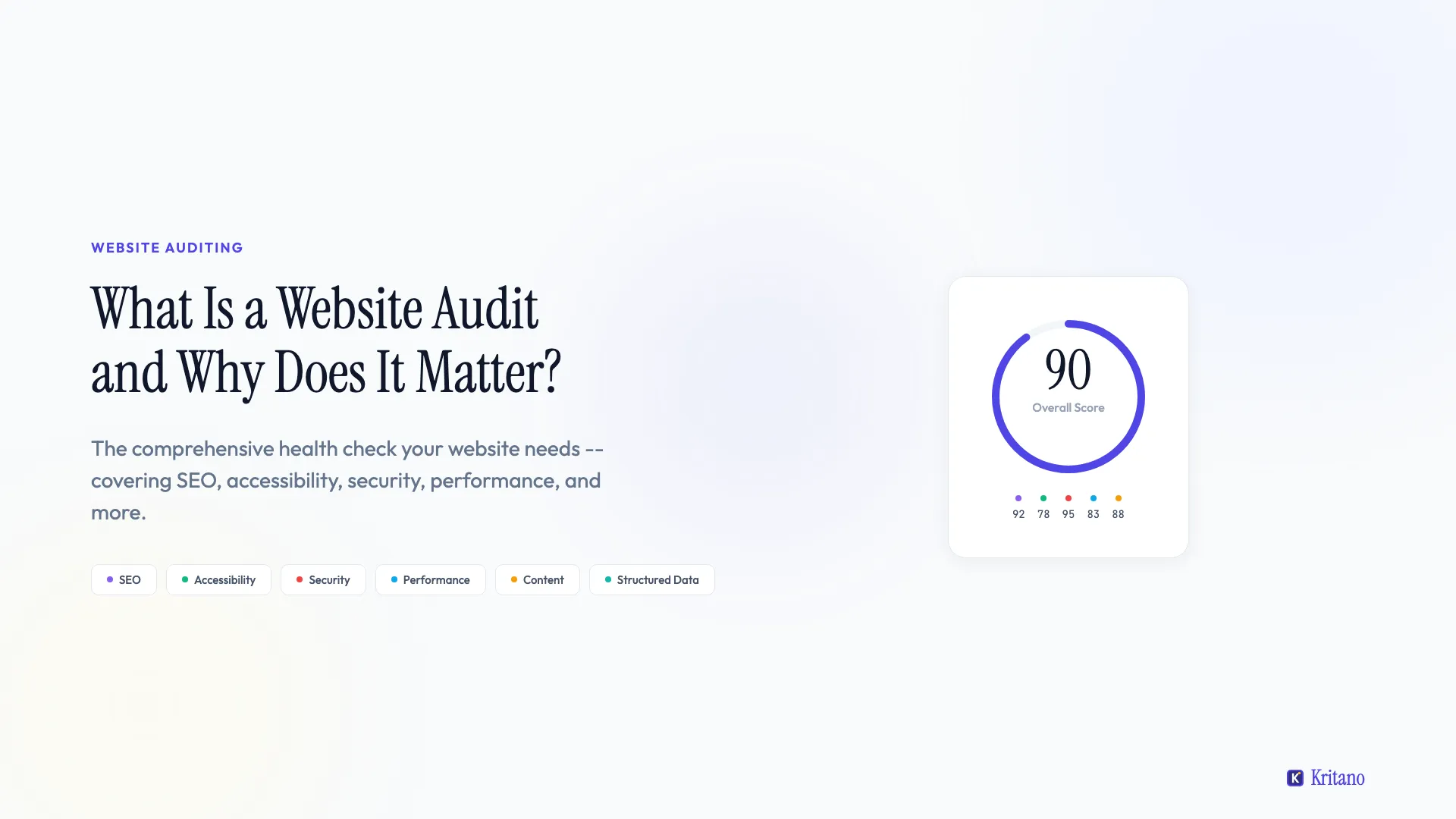
Most audits cover six core areas:
- SEO - Can search engines find, understand, and rank your pages?
- Accessibility - Can everyone use your website, including people with disabilities?
- Security - Is your site protected against common vulnerabilities?
- Performance - Does your site load quickly on all devices?
- Content quality - Is your content well-structured, authoritative, and useful?
- Structured data - Does your site speak the language that search engines and AI assistants understand?
Each of these is a discipline in its own right, and that's why auditing tools exist - no one person can manually check hundreds of rules across hundreds of pages.
Why Your Business Needs a Website Audit
Here's the honest truth: most websites have issues. Not because the people who built them did a bad job, but because the web moves fast. Standards change, browsers update, Google adjusts its algorithm, and new accessibility requirements come into effect. What was best practice two years ago might be holding you back today.
You're losing traffic you don't know about
If your meta titles are duplicated, your headings are out of order, or your sitemap is missing pages, Google is struggling to index your content properly. You won't see an error message - you'll just quietly rank lower than you should. An SEO audit catches these invisible problems.
You might be breaking the law
The European Accessibility Act (EAA) comes into full effect in June 2025, and the UK's Equality Act already requires websites to be accessible. If someone using a screen reader can't navigate your checkout process, or your colour contrast fails WCAG 2.2 guidelines, you're not just providing a poor experience - you're potentially liable. An accessibility audit tells you exactly where you stand.
Slow sites lose customers
Studies consistently show that 53% of mobile users abandon a site that takes longer than 3 seconds to load. Your Core Web Vitals - the specific metrics Google uses to measure real-world user experience - directly affect your search rankings. A performance audit measures your LCP (Largest Contentful Paint), INP (Interaction to Next Paint), and CLS (Cumulative Layout Shift) and tells you what's slowing things down.
Security gaps are invisible until they're not
An SSL certificate is the bare minimum. But what about your security headers? Are you sending a Content Security Policy? Is your X-Frame-Options header set? Are there exposed files or directories that shouldn't be public? A security audit checks 40+ potential vulnerabilities that most site owners have never heard of.
What Does a Website Audit Actually Check?
Let me walk through each area so you know what to expect.
SEO Auditing
An SEO audit looks at how well your site is optimised for search engines. This includes over 100 individual checks:
- Meta tags - Are your title tags unique, the right length, and keyword-optimised? Do you have meta descriptions on every page?
- Heading hierarchy - Is there exactly one H1 per page? Do your headings follow a logical structure (H1, H2, H3) without skipping levels?
- Internal linking - Are your pages well connected? Can Google crawl from any page to any other page?
- Broken links - Dead links hurt both user experience and search rankings
- Mobile-friendliness - Google uses mobile-first indexing, so your mobile experience is what gets ranked
- Sitemap and robots.txt - Are you telling search engines what to crawl and what to ignore?
The goal is to remove every obstacle between your content and the people searching for it.
Accessibility Auditing
Accessibility isn't just about compliance - it's about making sure everyone can use your website. An accessibility audit tests against WCAG 2.2 Level AA, the international standard. Key checks include:
- Colour contrast - Is your text readable against its background?
- Keyboard navigation - Can someone navigate your entire site without a mouse?
- Screen reader compatibility - Do images have alt text? Are form fields properly labelled?
- ARIA attributes - Are interactive elements (dropdowns, modals, tabs) announced correctly to assistive technology?
- Focus indicators - Can keyboard users see where they are on the page?
I've audited sites that looked perfectly fine visually but were completely unusable with a screen reader. These aren't edge cases - roughly 16% of the world's population lives with some form of disability.
Security Scanning
A security audit goes beyond checking for an SSL padlock. It examines:
- HTTPS configuration - Is your certificate valid, and are all resources loaded securely?
- Security headers - Content Security Policy, Strict-Transport-Security, X-Content-Type-Options, and more
- Exposed files - Are your
.envfiles, database backups, or admin directories publicly accessible? - Mixed content - Are any resources (images, scripts, fonts) still loading over HTTP?
- Cookie security - Are your cookies marked as Secure, HttpOnly, and SameSite?
Most of these fixes take minutes to implement but can prevent serious breaches. It's one of those areas where a small investment of time pays enormous dividends.
Performance Analysis
Performance is measured using real-world metrics that affect both user experience and search rankings:
- LCP (Largest Contentful Paint) - How long until the main content is visible. Aim for under 2.5 seconds.
- INP (Interaction to Next Paint) - How quickly the page responds to user input. Aim for under 200ms.
- CLS (Cumulative Layout Shift) - How much the page layout jumps around during loading. Aim for under 0.1.
- Resource optimisation - Are images compressed? Are scripts minified? Is caching configured?
- Render-blocking resources - Are CSS or JavaScript files delaying the initial render?
You can check your own scores right now using Google PageSpeed Insights - just pop in your URL.
Content Quality
This is the area most audits miss, but it's increasingly important for both search rankings and AI citation. Content quality auditing examines:
- E-E-A-T signals - Experience, Expertise, Authoritativeness, and Trustworthiness. Does your content demonstrate real knowledge?
- Readability - Is your content written at an appropriate level for your audience?
- Factual density - Are there enough specific claims, data points, and examples for AI engines to cite?
- Author attribution - Is it clear who wrote the content and why they're qualified?
- Freshness - When was the content last updated?
With AI-powered search engines like ChatGPT, Perplexity, and Google's AI Overviews becoming mainstream, content quality directly affects whether your business gets cited in AI-generated answers. This is what we call Answer Engine Optimisation (AEO) - making your content structured and authoritative enough that AI chooses to reference it.
Structured Data
Structured data is the behind-the-scenes markup that helps search engines understand your content. A structured data audit checks:
- Schema.org markup - Do you have the right schema types for your content (Article, Product, FAQ, HowTo)?
- JSON-LD validity - Is your structured data properly formatted and error-free?
- Rich result eligibility - Could your content appear as a rich snippet, FAQ dropdown, or knowledge panel in search results?
- Completeness - Are required and recommended properties present?
Proper structured data doesn't guarantee rich results, but without it, you're definitely not getting them.
What to Do With Your Audit Results
An audit report is only useful if you act on it. Here's how I'd approach the results:
1. Fix critical issues first. Anything that's broken - 404 errors, security vulnerabilities, missing SSL - gets fixed immediately. These are actively hurting you right now.
2. Tackle high-impact, low-effort wins. Missing meta descriptions, uncompressed images, absent alt text - these are quick fixes with measurable impact.
3. Plan for the bigger stuff. Some findings - like restructuring your heading hierarchy or implementing a full content strategy - require more time. Schedule them rather than ignoring them.
4. Re-audit regularly. Your website isn't static. New content gets added, plugins update, standards evolve. I'd recommend a full audit at least quarterly, with continuous monitoring for critical issues.
The Honest Trade-Off
A comprehensive website audit takes time, and acting on the results takes effort. There's no magic button that fixes everything overnight. But the alternative - running a website blind, not knowing what's broken, and wondering why your traffic is flat - is far more costly in the long run.
The businesses I've seen get the best results are the ones that treat their website like a product, not a brochure. They measure, they fix, they iterate. And it starts with knowing where you stand.
The Bottom Line
A website audit is the single most valuable thing you can do for your online presence. It tells you exactly what's working, what's broken, and what to fix first - across SEO, accessibility, security, performance, content, and structured data. Whether you do it yourself with free tools or use a platform like Kritano that checks everything in one scan, the important thing is that you do it.
If you want to see how your website stacks up, run a free audit and I'll walk you through what comes back. No jargon, no pressure - just a clear picture of where things stand.

Founder of Kritano
5 years in web development. I specialise in web auditing, WCAG 2.2 compliance, and search engine optimisation.
I built Kritano after years of running audits with fragmented tools. I write about SEO, accessibility, security, and performance based on real auditing data from thousands of scans.