The ADA Web Accessibility Deadline Just Got Extended
Here's What It Means
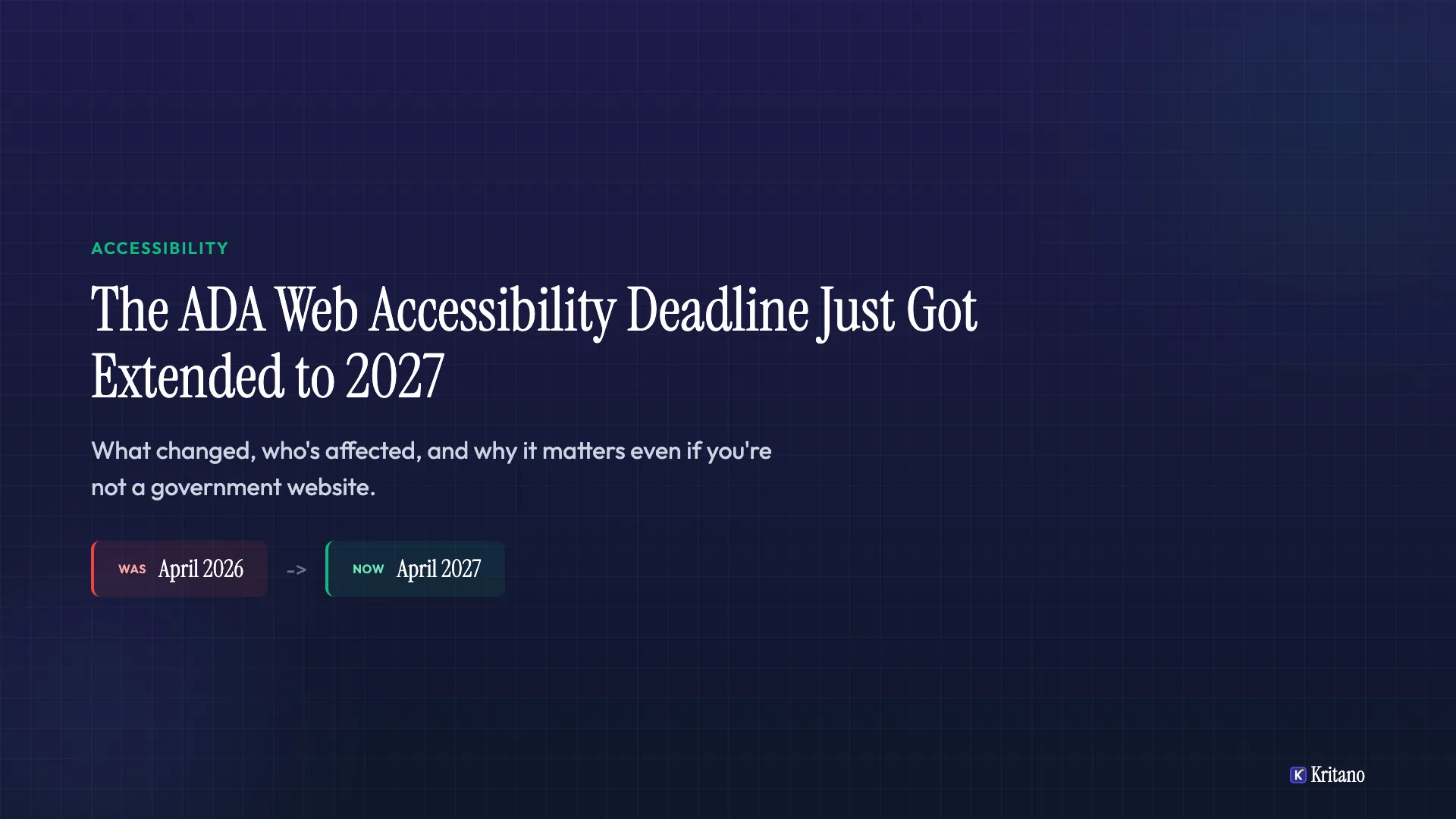
The deadline that was supposed to force thousands of government websites to become accessible just got pushed back by a year. And the reaction has been split right down the middle.
On April 20, the US Department of Justice published a new interim final rule extending the ADA Title II web accessibility compliance deadline. The original date was days away. Schools, councils, and public institutions that had been scrambling to comply were given breathing room. Disability advocates were furious.
Whether you're a government entity directly affected by this rule or a private business watching from the sidelines, this matters. Because the direction of travel hasn't changed - only the timeline.
What Just Happened?
The US Department of Justice has extended the ADA web accessibility compliance deadline by one year. Large public entities (population 50,000+) now have until April 26, 2027 instead of April 24, 2026. Smaller entities have until April 26, 2028 instead of April 26, 2027.
The original rule was published in April 2024 and required all state and local government websites and mobile apps to meet WCAG 2.1 Level AA - the international standard for web accessibility. It was the first time the US federal government had set specific technical standards for digital accessibility under the ADA.
Then, with days to spare before the first deadline hit, the DOJ pulled the handbrake.
The New Deadlines at a Glance
| Entity Type | Old Deadline | New Deadline |
|---|---|---|
| Large public entities (population 50,000+) | April 24, 2026 | April 26, 2027 |
| Smaller public entities and special districts | April 26, 2027 | April 26, 2028 |
The technical standard hasn't changed - it's still WCAG 2.1 Level AA. The scope hasn't changed - it still covers websites, mobile apps, and digital content. Only the dates moved.
Why the DOJ Extended the Deadline
The DOJ's reasoning was blunt. In the Federal Register notice, they stated they "overestimated the capabilities (whether staffing or technology) of covered entities to comply with the rule in the time frames provided."
Translation: most organisations weren't ready, and the DOJ knew it.
The reality on the ground backs this up. Schools that received the rule in 2024 had just two years to audit, remediate, and test every piece of digital content they publish. For a university with thousands of pages, hundreds of PDFs, and legacy systems built over decades, that's a massive undertaking.
The DOJ received correspondence from education advocacy organisations emphasising limited financial, technical, and staffing resources. Many institutions simply didn't have the expertise in-house to assess WCAG compliance, let alone fix it at scale.
Why Disability Advocates Are Angry
The extension didn't land well with everyone. The Coalition on Accessibility in Higher Education called the delay "unconscionable" in a public statement.
Their argument is straightforward: people with disabilities have been waiting decades for enforceable digital accessibility standards. The 2024 rule was a landmark moment - the first federal regulation setting concrete technical requirements for government websites. Pushing it back sends a signal that administrative convenience matters more than civil rights.
"At a time when the Department of Justice should be focused on providing technical assistance to help public entities achieve compliance, this delay undermines the key goal of providing access to critical information for people with disabilities," the Coalition wrote.
They have a point. The ADA was signed into law in 1990. It took until 2024 to get specific web accessibility standards. Another year's delay means another year of inaccessible government services for millions of people.
But in my honest opinion, this is more nuanced than either side wants to admit. A deadline that nobody can meet doesn't improve accessibility - it just creates a compliance crisis. The extension gives organisations time to do it properly rather than rushing a surface-level fix. The real failure wasn't the extension - it was the lack of funding and technical support to help entities comply in the first place.
This Doesn't Just Affect Government Websites
If you're running a private business website, you might think this doesn't apply to you. Technically, you're right - the DOJ's Title II rule only covers state and local government entities.
But here's what's happening in the background.
ADA Title III, which covers private businesses, doesn't have a specific WCAG standard written into law yet. That hasn't stopped plaintiffs. Website accessibility lawsuits against private businesses have been climbing year-on-year. Courts are increasingly treating WCAG 2.1 AA as the de facto standard, even without explicit federal regulation.
Meanwhile, the European Accessibility Act is now in force across the EU. If you serve European customers, you already have compliance obligations.
And then there's the SEO angle. 96% of websites still fail basic accessibility checks. Google's March 2026 core update made it clear that user experience signals - including accessibility - are weighing more heavily in rankings. Accessible websites perform better in search, period.
The regulatory direction is one-way. Accessibility standards are getting stricter, not looser. This deadline extension is a pause, not a reversal.
What 96% of Websites Are Getting Wrong Right Now
The WebAIM Million study consistently shows the same failures across the web:
- Missing alt text - the single most common accessibility violation. Screen reader users can't understand images without it.
- Low colour contrast - text that's too light against its background. Affects everyone, not just people with visual impairments.
- Missing form labels - form fields without associated labels are unusable with assistive technology.
- Empty links - links with no text content that screen readers can't announce.
- Missing document language - without a
langattribute, screen readers don't know what language to use.
These aren't edge cases or advanced WCAG criteria. These are the basics. And the vast majority of websites are failing them.
The good news is that these are also the easiest issues to fix. Adding alt text, improving contrast, and labelling forms are straightforward changes that make a measurable difference to both accessibility scores and real user experience.
What You Should Do Now (Whether the Deadline Applies to You or Not)
Run an accessibility audit
You can't fix what you can't see. The first step is understanding where your site stands. Run an accessibility audit against WCAG 2.1 AA standards to get a clear picture of your violations, sorted by severity.
Kritano checks accessibility alongside SEO, security, performance, and content quality in a single scan - so you'll see the full picture, not just one slice.
Fix the quick wins first
Alt text, colour contrast, and form labels are the three changes that make the biggest impact with the least effort. Most sites can fix 30-40% of their violations in a single afternoon by tackling these three areas.
Don't wait for the deadline
Whether you're a government entity with a 2027 deadline or a private business with no deadline at all, the best time to start is now. Accessibility isn't just compliance - it's better user experience, better SEO, and a wider audience.
If you want to understand what a website audit actually checks and why it matters beyond accessibility, that's a good starting point.
Frequently Asked Questions
What is the new ADA web accessibility deadline?
The DOJ extended the compliance deadline for large public entities (population 50,000+) from April 24, 2026 to April 26, 2027. Smaller entities now have until April 26, 2028. The technical standard remains WCAG 2.1 Level AA.
Does the ADA web accessibility deadline apply to private businesses?
The DOJ's Title II rule applies specifically to state and local government websites. However, private businesses face separate ADA obligations under Title III, and the number of accessibility lawsuits against private websites continues to rise year-on-year.
What standard do websites need to meet for ADA compliance?
The DOJ requires websites to meet WCAG 2.1 Level AA - the international standard for web accessibility. This covers alt text, colour contrast, keyboard navigation, form labels, video captions, and more.
How do I check if my website is ADA compliant?
Run a website accessibility audit using a tool that checks against WCAG 2.1 AA guidelines. This identifies specific violations like missing alt text, poor contrast, and keyboard traps, with guidance on how to fix each one.
Why was the ADA accessibility deadline extended?
The DOJ stated it "overestimated the capabilities" of covered entities to comply in time, citing limited financial, technical, and staffing resources. Disability advocates criticised the delay, calling it "unconscionable."
My Take
This deadline extension is a reality check, not a free pass. The DOJ is effectively admitting that the infrastructure for digital accessibility compliance doesn't exist at scale yet - not in government, not in education, and certainly not in the private sector.
But the direction hasn't changed. The standard is WCAG 2.1 AA. The lawsuits are increasing. The EU is already enforcing. And Google is rewarding accessible sites with better rankings.
If you're treating accessibility as something you'll "get to eventually", eventually just got one year closer. Use this time to actually do it - join the waitlist and get ready to run an audit, fix the basics, and build accessibility into your process rather than bolting it on at the last minute.
The deadline moved. The need didn't.

Founder of Kritano
5 years in web development. I specialise in web auditing, WCAG 2.2 compliance, and search engine optimisation.
I built Kritano after years of running audits with fragmented tools. I write about SEO, accessibility, security, and performance based on real auditing data from thousands of scans.